
Balancing Pinniped and Salmonid Recovery
Harbor seals and sea lions are vital parts of our marine ecosystem, but their growing populations create challenges for recovering threatened and endangered salmon and steelhead. The Pinniped Predation on Salmonids Project brings together scientists, tribes, and other partners to understand how seals interact with salmonids across Puget Sound, to help resource managers make better decisions for species recovery.
Pinnipeds in Puget Sound
Harbor seals, which are native to the Pacific Northwest, have seen their populations rebound significantly since the enactment of the federal Marine Mammal Protection Act of 1972 that protected the species.
This population growth has led to increasing predation impacts on multiple life stages of multiple species of salmon and steelhead listed as endangered or threatened under the Endangered Species Act. Managers lack the data needed to understand and quantify these predator-prey interactions, information that is vital to making sound salmon management decisions for the region.
The Pinniped Predation on Salmonids Project
The Pinniped Predation on Salmonids Project is a collaborative, year-long intensive investigation. The project will examine how the magnitude of harbor seal predation varies throughout the year and at different sites in Puget Sound and Hood Canal.
The project focuses on two representative estuary sites: Nisqually River in Puget Sound and the Duckabush/Dosewallips River estuaries in Hood Canal. We monitor these sites to quantify the magnitude of harbor seal predation on juvenile, resident, and adult life stages of steelhead and Chinook, chum, coho, and pink salmon as they migrate through ecologically diverse and seasonally variable habitats.
Over the course of the project, the team will collect data needed to determine whether harbor seal predation takes place at a level that limits the recovery of imperiled species like Chinook salmon and steelhead.
The project combines data that has never been simultaneously collected anywhere in the Pacific Northwest. This data will provide the most complete and credible picture to date of harbor seal predation pressure on salmonids at all life stages. The team will track:
- Harbor seal counts using aerial drone surveys
- Diet analysis from scat samples
- Behavior via GPS tagging
- Acoustic telemetry to detect predation on tagged salmonids
The Team at Work
Seal Tagging and Behavior
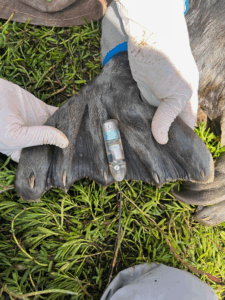
Researchers tagged harbor seals in both Hood Canal and Nisqually River estuaries to understand their movement and foraging behavior.
In total, researchers tagged 22 harbor seals in Hood Canal and 31 harbor seals in Nisqually with GPS tags in the fall on 2024 and spring of 2025.
When harbor seals temporarily leave the water and come ashore, it is called “hauling out.” Haulout patterns vary by season, reproductive cycle, and prey behavior. The team monitors these patterns with aerial surveys. To make sure the aerial counts are accurate, researchers need to know how much time seals spend resting on land versus swimming in the water.
Flipper-mounted SPOT satellite tags record how much time seals spend in and out of the water at different tide cycles, times of day, or season. Data from the tags will help the team infer foraging and resting behavior specific to each monitored haulout site. It will also help estimate the proportion of animals targeting out-migrating salmonids.
Additionally, a subsample of back mounted tags were used to collect fine scale GPS location and diving behavior data.
The team will use this data to compare behavioral and distribution information between estuaries to identify how environmental and ecological conditions contribute to differences in predation behavior activity.
 Drone Surveys
 Drone Surveys
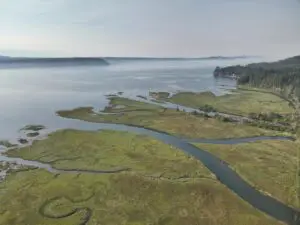
Aerial drone surveys are helping the team track harbor seal abundance. Prior to this project, aerial surveys were done once a year. During the project, the drone surveys will occur two or three times a month over primary haulouts in the Dosewallips and Duckabush (Hood Canal) and Nisqually estuaries.
Over the course of the project, the team will perform approximately 24 drone surveys per site in both Hood Canal and the Nisqually estuaries.
Diet Analysis
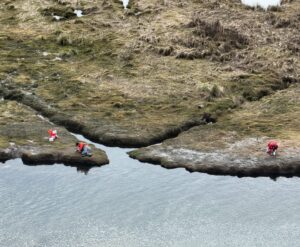
Each month, the team is collecting and analyzing scat samples at the Dosewallips, Duckabush, and Nisqually River haulouts to determine what seals are eating.
By combining the following methods, the team can identify which salmon species and age groups the seals are eating at each site:
- DNA metabarcoding: Reveals what prey species were present and in what proportions they appeared in the diet.
- Hard-part analysis: Indicates what size/age class of prey were being consumed.
To find the amount of salmon the seals are eating each month, the team will multiply the amount of harbor seal scat with salmonid pieces in it (averaged over each month), by how much the seals eat each day (2.1 kg food/day; Howard et al. 2013), and then by the average number of harbor seals in each sampled estuary.
The team has collected 1,048 scat samples from Hood Canal and 951 scat samples from the Nisqually estuary.
Telemetry-Based Predation
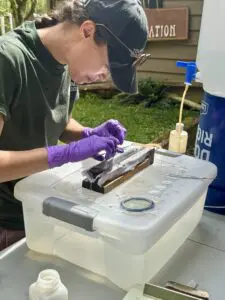
For another measure of predation, project researchers tagged steelhead smolts from the Duckabush River, and steelhead and Chinook smolts from the Nisqually River with acoustic transmitters. The tags implanted in steelhead smolts are equipped with temperature sensors that signal when a consumed by a marine animal or avian predator. The smaller Chinook smolt tags transmit a unique code when they are exposed to stomach acid.
This acoustic telemetry data could:
- Provide new information about harbor seal predation of subyearling Chinook salmon
- Help compare steelhead predation in the Duckabush River to established patterns of steelhead predation in the Nisqually River estuary
- Provide a telemetry-based predation estimate to better calibrate and further refine model-based predation estimates
By pairing these data with movement and behavioral information, the team can estimate harbor seal predation mortality rates for each tagged species in each estuary. During data collection, the acoustic tags tracked 120 steelhead on the Duckabush River. They also tracked 100 steelhead and 179 Chinook on the Nisqually River.
Related Research
Other ongoing research about the region’s pinnipeds includes monitoring the numbers of harbor seals, conducting a comprehensive Southern Puget Sound diet study, assessing predation impacts on Stillaguamish River Chinook, and mapping pinniped “hotspots.”
Hood Canal Bridge
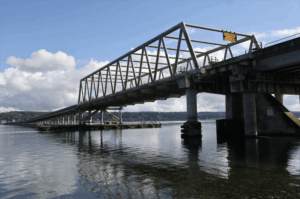
Another pinch point in salmonid migration is the Hood Canal Bridge, which extends under the surface of the canal, causing migration delay of ESA-listed steelhead smolts. Harbor seal predation is the primary driver of mortality at the bridge, where up to half of migrating steelhead smolts are consumed (Moore & Berejikian 2022).
Partners are testing the efficacy of Targeted Acoustic Startle Technology, a device that emits static-like sound meant to deter pinnipeds, at locations including Capitol Lake in Olympia, the Ballard Locks in Seattle, Whatcom Creek in Bellingham, and at the Hood Canal Bridge. Results so far suggest the devices are moderately effective at deterring harbor seals from key predation hotspots such as fish ladders, potentially providing a reprieve for migrating fish in the immediate vicinity.