

Hot Temps Mean Problems for Salmon
Salmon are woven into the identity of the Pacific Northwest: culturally, economically, and ecologically. But this summer has been notably hot for both people and the environment, and as climate change progresses, essential snowpacks are becoming less reliable sources of cool water for migrating fish. With the number of hot days rising, salmon that depend on cool waters to thrive face even greater challenges to their migrations.
Can’t Beat the Heat
During the June 2021 heat wave, when Seattle reached a record-breaking 108°F, dead sockeye were found around the Ballard Locks’ fish ladder. High water temperatures have been a problem in the Lake Washington Ship Canal for more than two decades, and the problem is only getting worse.
 Salmon thrive in cool waters up to about 59 degrees, whether in freshwater rivers, streams, estuaries, or the ocean. When salmon are stressed, they are more susceptible to disease and toxics. If water temperatures reach 72 degrees or higher, prolonged exposure can even be fatal. High water temperatures can also serve as a barrier to migrating salmon, causing delays in their journey.
Warm water doesn’t just add stress to salmon. It speeds up their metabolism. This can mean eggs hatch too soon, leading to fry (baby salmon) that are smaller and less likely to survive. An increased metabolism also means a greater need for food. The problem compounds as their best sources of nutrition, the mayfly, stonefly, and caddisfly nymphs, are also affected by warmer water and can die off, being replaced by lower-quality food sources like mosquito larvae.
Adult salmon stop feeding once they enter freshwater, so a heat-driven increase in metabolism means they’re burning through their fat reserves, leaving less energy to reach their spawning grounds upstream. At sea, where salmon spend their time trying to grow quickly, warmer ocean temperatures affect food sources too. Herring are a key source of nutrition that Chinook and coho. When herring are scarce and are replaced by other prey, salmon grow more slowly and their chance of survival drops.
The Oxygen Problem
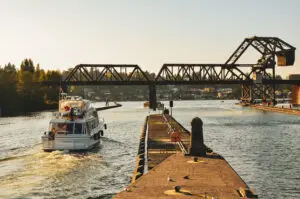 The Lake Washington Ship Canal often has areas that don’t have enough oxygen for salmon, and rising water temperatures make this issue worse. Heat can also create areas of lower dissolved oxygen, which is essentially the amount of breathable oxygen available to living organisms. Since heat causes gas molecules to move faster and escape into the air, warmer water holds less of it.
Migrating adult salmon rely on oxygen-rich water for the energy-intensive work of reaching spawning grounds. In low-oxygen conditions, their jumping height can decrease, making it harder to clear obstacles like waterfalls or dams.
Salmon will actively avoid low-oxygen areas altogether, which shrinks usable habitat for young and adult fish alike, and can delay migration as they wait for conditions to improve. In the most severe cases, low oxygen can lead to mass die-offs.
What Can We Do?
“The only way we can continue to have salmon pass through the locks and other areas across the Pacific Northwest is through the determination and care of people who want to preserve them,” said Lucas Hall, Chief Program Officer for Long Live the Kings. “We are proud to be part of the ongoing effort with our partners to find solutions to help these salmon.”
In natural areas where the terrain allows, restoration work like planting trees along streams for shade is a common and effective solution. To address low-oxygen areas, we can create riffles, which are shallow, turbulent stretches of water, often built using boulders or other structures, that work like a stream’s natural aerator, mixing air back into the water as it tumbles over and around them.
In industrial or urban areas, those same solutions aren’t always feasible. A prime example is Lake Union and the Ballard Locks, a shipping canal that connects Puget Sound to Lake Union where visitors can watch salmon swim past through an underwater viewing window. Migrating fish already contend with seals and human infrastructure here, and rising temperatures make things worse. Potential solutions do exist for urban environments, like pumping cool water from nearby sources or adding aeration zones to raise dissolved oxygen levels and lower water temperatures, creating rest and recovery spots for migrating salmon.